


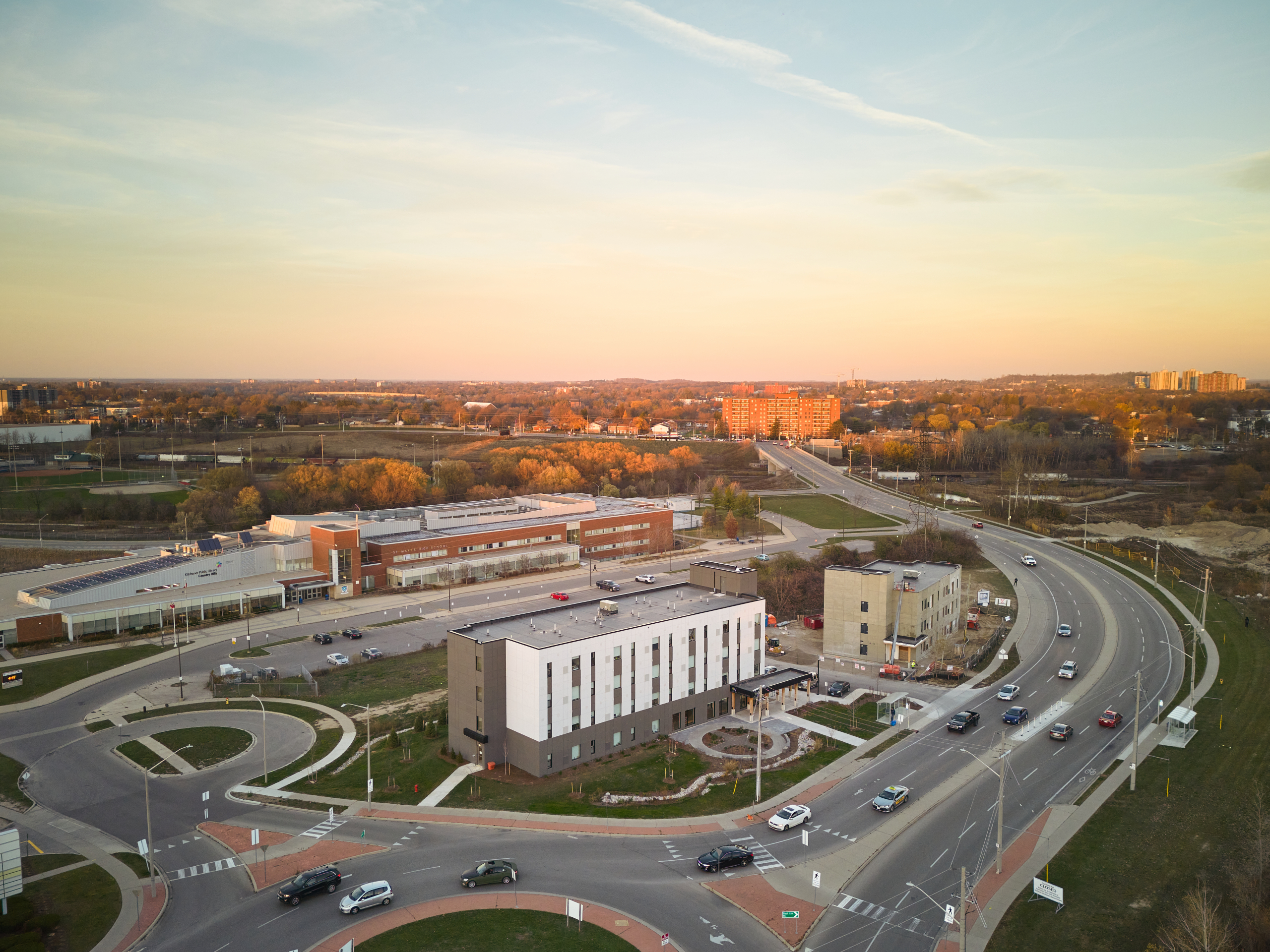
In just 12 months, 41 women experiencing homelessness in the Waterloo Region moved into new, permanent homes at the YW Kitchener-Waterloo’s Block Line Supportive Housing development. Delivered under the constraints of the CMHC Rapid Housing Initiative, the project offers a powerful case study in what becomes possible when motivated partners, innovative construction methods, and streamlined municipal processes align around a shared goal.
Located on a City of Kitchener-owned site near the Block Line ION transit station, the four-storey, 22,800 sq. ft. building provides self-contained studio apartments paired with wraparound support services. The City contributed the land through a long-term lease, enabling the YW to focus limited resources on delivering housing quickly and at scale. Occupancy began in April 2022, with a second, smaller family-oriented building opening next door in 2023.
Collaboration as the Real Innovation
While mass timber construction played a critical role in accelerating delivery, the deeper success of the project lies in how it was delivered. From the outset, the YW K-W acted as a team leader, aligning municipal partners, consultants, and builders around the non-negotiable requirement of delivering within a 12-month funding window.
To make this timeline possible, the City of Kitchener introduced a dedicated “housing concierge” role—an internal project lead responsible for coordinating approvals, aligning departments, and removing administrative barriers. This role reduced the typical site plan approval process from nearly a year to just 72 days and has since become a permanent position to support future housing initiatives.
The result was not just speed, but trust-based collaboration between public and non-profit partners—an approach that treated housing as shared civic infrastructure rather than a siloed development project.
Why Mass Timber Mattered
Block Line 1 was delivered using a mass timber, design-build approach, with prefabricated CLT panels and glulam columns manufactured off-site and assembled in just 20 days. This significantly reduced on-site construction time, improved quality control, and allowed the team to meet the aggressive schedule required by the Rapid Housing Initiative.
Beyond speed, mass timber brought additional benefits: lower embodied carbon, improved acoustic performance, inherent fire resistance, and warm, exposed wood interiors that contribute to a sense of dignity and comfort for residents. The building was recognized with both the Sustainable Kitchener Award and the Ontario Wood WORKS! Award, reinforcing that industrialized construction does not need to compromise design quality.
Designing for Dignity, Not Just Density
Each unit is intentionally compact—about 337 square feet—with private kitchen, bathroom, and bedroom. While modest in size, these spaces provide what shelters cannot: privacy, security, and control. For many residents, having a door that locks represents a foundational step toward stability and independence.
The building includes shared support spaces and decentralized mechanical systems, allowing residents to control their own environments while staff maintain oversight and safety. The design balances operational efficiency with trauma-informed principles, recognizing that supportive housing is not just about shelter, but about rebuilding agency.
A Replicable Model for Canadian Cities
The Block Line project demonstrates that supportive housing can be delivered faster, more affordably, and with higher quality when:
- Non-profits are empowered as project leaders.
- Municipalities act as enablers, not just regulators.
- Industrialized construction methods are integrated early.
- Teams commit to transparency, accountability, and shared problem-solving.
At a construction cost of approximately $181,000 per unit—delivered on budget despite pandemic-era inflation—the project stands in stark contrast to other modular housing pilots that experienced significant overruns and delays.
For mcCallumSather, Block Line reinforces a core belief that housing delivery is not a technical problem alone—it is a systems problem. Solving it requires integrated design, collaborative governance, and the willingness to rethink traditional roles and processes.
Most importantly, it shows that when design teams, municipalities, and community organizations stay present through complexity, supportive housing can be delivered not as emergency infrastructure, but as lasting, dignified places to live.
Read the full case study here: Accelerated Supportive Housing Through Innovative and Strategic Partnerships by Karen Shlesinger, James McKellar, Lyndsey Rolheiser :: SSRN


